Deepfake Video Detection
Evaluate clips for face-swapping, lip-sync manipulation, facial jitter, and temporal inconsistencies tied to generative video models like Sora 2, Veo 3, and Kling.
Open Deepfake Video DetectorAIGuardian
Visual AI Forensics & Deepfake Detection
Frame-level forensics, face-swap detection, and visual artifact analysis for security teams, media organizations, and fraud prevention. Explainable signals, not black-box verdicts.
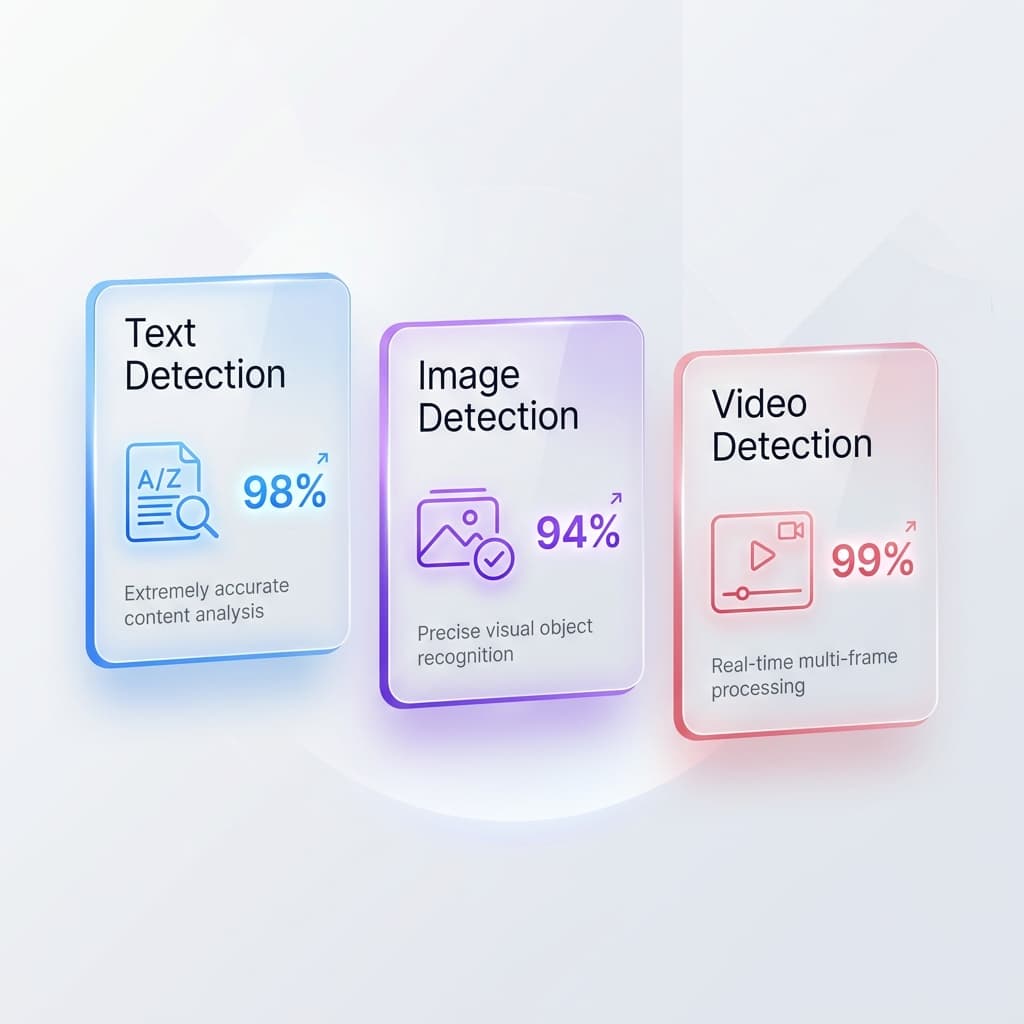
Specialized forensic modules for generative video, synthetic images, and multimodal media—trained on cutting-edge diffusion and generative architectures for audit-ready review.
Evaluate clips for face-swapping, lip-sync manipulation, facial jitter, and temporal inconsistencies tied to generative video models like Sora 2, Veo 3, and Kling.
Open Deepfake Video DetectorIdentify synthetic imagery from Midjourney, FLUX.1, DALL·E 3, Grok Imagine, and Stable Diffusion using frequency-domain (FFT) and diffusion artifact analysis.
Open AI Image DetectorScreen video calls, KYC presentations, and social media clips for biometric face-swapping and synthetic audio-visual manipulation.
Explore Deepfake GuideWatch AIGuardian run a visual media forensics review: detect deepfake video, inspect synthetic image artifacts from diffusion models, and verify media authenticity—in one explainable workflow.
Prefer a new tab? Open the AIGuardian demo on YouTube
Beyond surface-level heuristics: multi-frame temporal consistency, frequency-domain FFT analysis, and cryptographic provenance to support defensible verification.
Analyze video sequences frame-by-frame for facial warping, temporal flicker, and biological inconsistencies that expose generative manipulation.
Inspect high-frequency spatial anomalies, abnormal sensor noise distributions, and generative diffusion signatures invisible to the naked eye.
Receive probabilistic confidence breakdowns paired with explainable signals and provenance data for defensible human-in-the-loop review.
Engineered for visual media authenticity: explainable forensic signals, low false-positive calibration, and instant self-serve access without enterprise lock-in.
Organizations and professionals defending trust, digital authenticity, and media integrity.
Screen user-generated media for synthetic manipulation, face-swap scams, and identity fraud before broadcast or publish.
Verify breaking news imagery, viral video clips, and source media authenticity before reporting.
Protect identity verification pipelines against synthetic face injection, presentation attacks, and deepfake impersonation.
Audit visual assets and protect brand authenticity against unauthorized AI clone generation.
Analyze media evidence with explainable frequency-domain signatures and provenance verification.
Review student multimedia projects, digital artwork, and synthetic media with fair, explainable signals.
Product tools execute forensic scans. These solution playbooks guide investigators on applying signals to real-world verification challenges.
Practical steps for evaluating suspected deepfake video, facial manipulation, and synthetic media.
Review playbook for Google Gemini multimodal image and video generation in editorial workflows.
How temporal consistency analysis catches synthetic physics and generative anomalies.
Identifying AI face-swaps in real-time video calls, financial phishing, and social media.
As generative video models (such as Sora 2, Kling, and Veo 3) and image diffusion engines (like FLUX.1 and Midjourney v6) evolve, synthetic media has become virtually indistinguishable from optical camera capture to the human eye. Modern digital forensics relies on identifying the subtle mathematical and statistical fingerprints left by generative synthesis.
Our video detection pipeline investigates temporal consistency across consecutive frames, tracking facial landmark stability, abnormal optical flow, and unnatural reflections that reveal face-swap or generative synthesis. In static images, frequency-domain (FFT) analysis exposes abnormal high-frequency energy distributions and diffusion denoising signatures.
Complementing visual forensics, AIGuardian supports cryptographic provenance standards (such as C2PA Content Credentials) and multimodal visual forensics—providing security investigators, newsrooms, and trust & safety teams with multi-layered, defensible evidence for informed decision-making.
Flexible plans for deepfake video, AI image, and multimodal detection — choose the quota that fits your team.
AIGuardian uses trained computer vision and forensic classifiers to analyze frame-to-frame temporal consistency, facial landmarks, frequency-domain (FFT) anomalies, and diffusion artifacts across video and images, alongside multimodal visual forensics. Scores are probabilistic signals for human review.
AIGuardian is free to sign up and includes daily credits — claim them via daily check-in, or watch rewarded videos in the mobile app. For higher-volume investigative pipelines, choose Weekly, Monthly, Quarterly, or Annual plans.
AIGuardian specializes in deepfake video detection (Sora 2, Kling, Veo 3, Runway) and synthetic image forensics (Midjourney, FLUX.1, DALL·E 3, Stable Diffusion), delivering frame-level temporal consistency and frequency-domain artifact analysis.
While recompression and social media filters can obscure superficial artifacts, AIGuardian examines underlying pixel-level frequency spectra and biological temporal consistency (such as eye reflections and facial warping) that survive re-encoding.
No AI detector is 100% accurate. AIGuardian delivers probabilistic confidence scores and visual artifact signals calibrated to minimize false positives, designed to empower trust & safety teams, journalists, and security professionals.
C2PA cryptographic provenance tracks content creation at the source. Because social networks often strip metadata, AIGuardian forensic pixel and frame analysis provides essential verification when metadata is absent.
Yes. All uploads are processed via encrypted TLS 1.3 connections. Files are inspected in volatile memory and deleted immediately after analysis completes—never used to train models or stored permanently.
Treat scores as explainable evidentiary signals, not automatic binary verdicts. Pair detector heatmaps with source verification, provenance checks, and expert review before making legal, editorial, or enforcement decisions.